

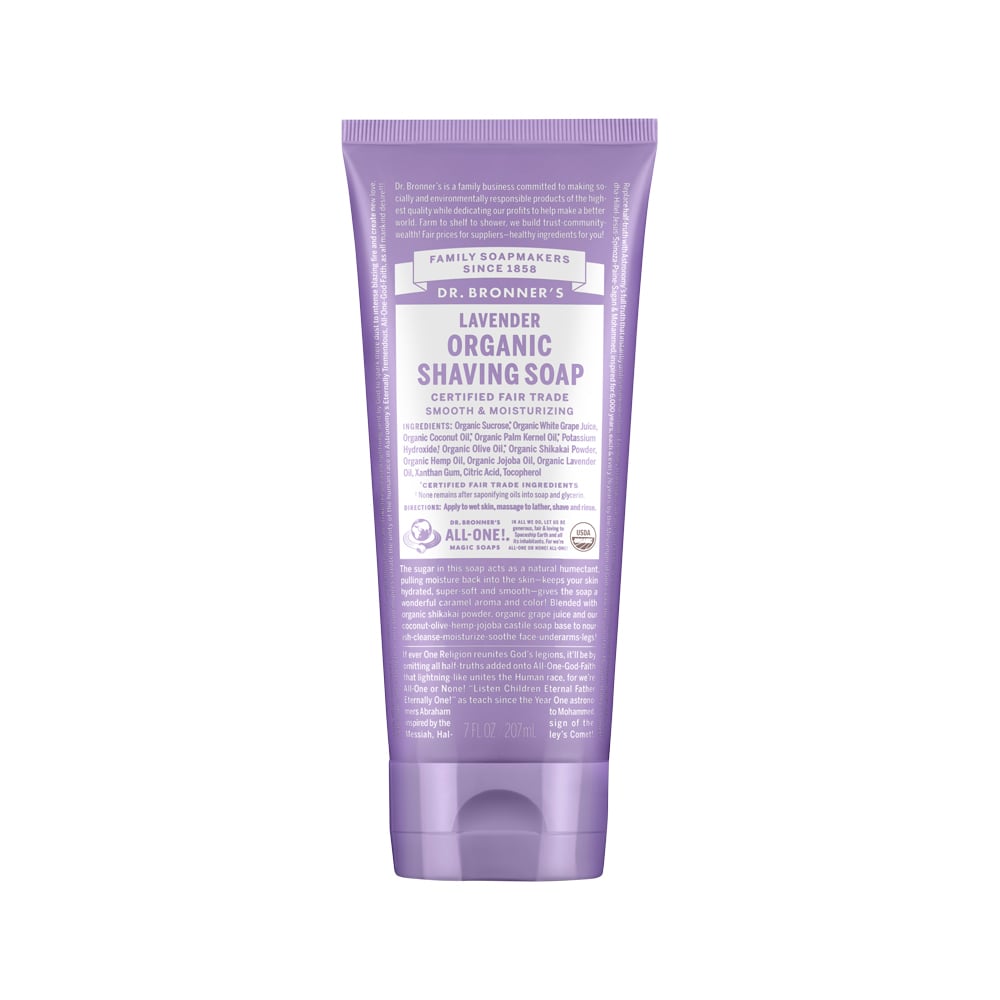
Dr. Bronner’s Organic Shaving Soap – Lavender

Dr. Bronner’s Organic Shaving Soap Lavender is a certified organic shaving gel designed to provide a smooth, comfortable shave while helping to condition and moisturise the skin. Infused with organic lavender, it creates a rich lather and soothing glide for effective shaving without synthetic ingredients.

$24.59

SKU 2622364 Category

Certified Organic

Certification

Certified to USDA National Organic Program standards, this Fair Trade and organic shaving soap is formulated with organic shikakai, a traditional South Asian botanical that has been used for centuries as a gentle conditioning cleanser for skin and hair. Combined with Dr. Bronner’s pure-castile liquid soap base, organic sugar, and organic grape juice, it helps lift and soften hair while supporting a close, comfortable shave.

Suitable for both men and women, this versatile shaving soap can be used on the face, underarms, legs, and other areas of the body. The rich lather works best on moist skin and softened hair, helping to prepare the skin for a clean, smooth shave while leaving it feeling refreshed and cared for.

Features

  • Certified organic to USDA National Organic Program standards.
  • Suitable for men and women.
  • Helps provide a smooth, comfortable shave.
  • Made with organic shikakai.
  • Formulated with Dr. Bronner’s pure-castile soap base.
  • Helps soften and lift hair for easier shaving.
  • Creates a rich, moisturising lather.
  • Infused with organic lavender.
  • Free from synthetic ingredients.
  • Made with Fair Trade and organic ingredients.

Ingredients

Organic Sucrose*, Organic White Grape Juice, Organic Coconut Oil*, Organic Palm Kernel Oil*, Potassium Hydroxide**, Organic Olive Oil*, Organic Shikakai Powder, Organic Hemp Oil, Organic Jojoba Oil, Organic Lavender Oil, Xanthan Gum, Citric Acid, TTocopherol.

*Certified Fair Trade Ingredients.
**None remains after saponifying oils into soap & glycerin.

Customer Reviews

Online Sports Nutrition and Natural Dietetics.

Chances are there wasn't collaboration, communication, and checkpoints, there wasn't a process agreed upon or specified with the granularity required. It's content strategy gone awry right from the start. Forswearing the use of Lorem Ipsum wouldn't have helped, won't help now. It's like saying you're a bad designer, use less bold text, don't use italics in every other paragraph. True enough, but that's not all that it takes to get things back on track.

The villagers are out there with a vengeance to get that Frankenstein

You made all the required mock ups for commissioned layout, got all the approvals, built a tested code base or had them built, you decided on a content management system, got a license for it or adapted:

  • The toppings you may chose for that TV dinner pizza slice when you forgot to shop for foods, the paint you may slap on your face to impress the new boss is your business.
  • But what about your daily bread? Design comps, layouts, wireframes—will your clients accept that you go about things the facile way?
  • Authorities in our business will tell in no uncertain terms that Lorem Ipsum is that huge, huge no no to forswear forever.
  • Not so fast, I'd say, there are some redeeming factors in favor of greeking text, as its use is merely the symptom of a worse problem to take into consideration.
  • Websites in professional use templating systems.
  • Commercial publishing platforms and content management systems ensure that you can show different text, different data using the same template.
  • When it's about controlling hundreds of articles, product pages for web shops, or user profiles in social networks, all of them potentially with different sizes, formats, rules for differing elements things can break, designs agreed upon can have unintended consequences and look much different than expected.

This is quite a problem to solve, but just doing without greeking text won't fix it. Using test items of real content and data in designs will help, but there's no guarantee that every oddity will be found and corrected. Do you want to be sure? Then a prototype or beta site with real content published from the real CMS is needed—but you’re not going that far until you go through an initial design cycle.